Volli Communications Newsletter Issue 01 — Your analog fax line is a compliance time bomb
Your analog fax line is a compliance time bomb.
Issue 01 · Volli Communications · April 2026
The short version
If your practice still runs an analog fax line for patient records, referrals, or prior auths — you’re sitting on three problems at once.
One, the carriers are turning those lines off.
Two, HIPAA auditors are no longer grading analog fax on a curve.
Three, the replacements you’ve been pitched are either fragile or overpriced.
This is what’s actually happening, and what to do about it.
Fax didn’t die. It got absorbed.
Healthcare still moves on fax. Not nostalgia — infrastructure.
- 70% of all healthcare communication still runs on fax. 90% if you count EHR-integrated inbound and outbound. (Konica Minolta, 2025)
- 9 billion fax pages a year cross U.S. healthcare networks. (Codes Health, 2023)
- 56% of referrals are faxed. 90% of medical records requests are faxed. (Codes Health, 2023)
Every EHR vendor promised to kill it. None of them did. The interoperability gap between health systems turned fax into the universal adapter, and it stuck.
So fax isn’t the problem. The line underneath it is.
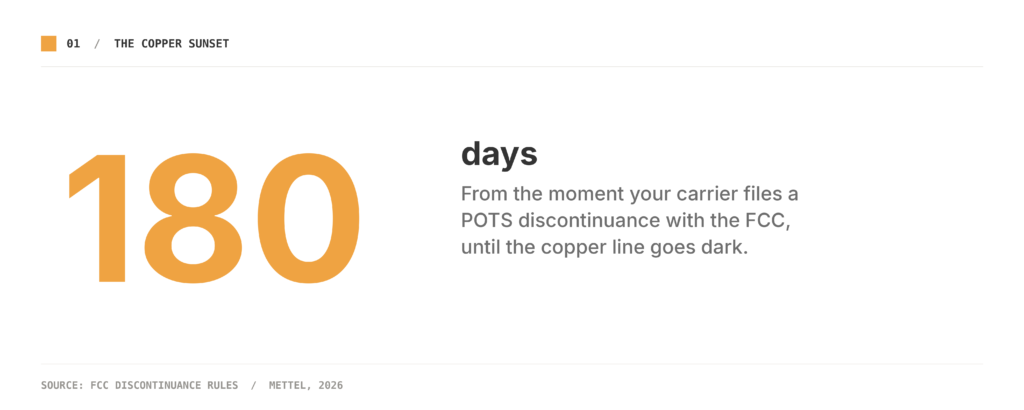
180 days — the clock from carrier discontinuance notice to copper line shutoff
The copper is going dark.
The FCC stopped requiring carriers to maintain analog POTS lines in 2022. AT&T is targeting a 50% cut in copper by end of 2025, full retirement by 2029. Verizon is on a similar curve. (Northern Arizona IT, 2025)
Here’s what that means in practice.
Price. Analog line pricing has gone from ~$40/month to $150–400/month in most metros over the last three years. Carriers aren’t trying to keep you — they’re pricing you out.
Reliability. Fewer techs. Longer repair windows. The copper in the street is 40 years old and nobody is replacing it.
Notice. Once a carrier files a discontinuance with the FCC, you have 180 days to transition or the line is gone. (MetTel, 2026)
If your compliance posture depends on a line the carrier is actively retiring, your compliance posture has a shelf life.
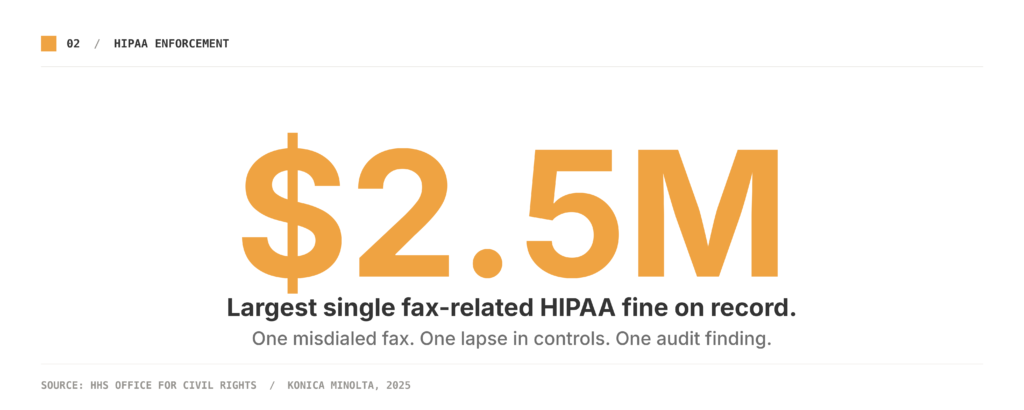
$2.5 million — largest single fax-related HIPAA fine on record
HIPAA auditors moved the goalposts.
The part most practices haven’t caught up to.
Traditional analog fax was grandfathered under HIPAA for years on the assumption that point-to-point analog transmission was reasonably secure. That assumption is gone.
The HHS Office for Civil Rights has issued multiple enforcement actions tied to fax-related breaches. The largest single fax fine on record: $2.5 million for faxing PHI to the wrong number. (Konica Minolta, 2025)
Modern HIPAA compliance for fax now requires (Documo, 2024):
- A signed BAA with your transmission provider
- TLS 1.2+ in transit, AES-256 at rest
- Unique user IDs, automatic logoff, audit logging per 45 CFR §164.312
- A documented breach notification process
An analog fax machine plugged into a copper line meets none of these structurally. You can layer administrative controls on top — locked rooms, cover sheets, confirmation logs — but auditors increasingly call those out as fragile and error-prone.
The quiet part: the BAA requirement alone disqualifies most traditional carriers. They won’t sign one for a POTS line.
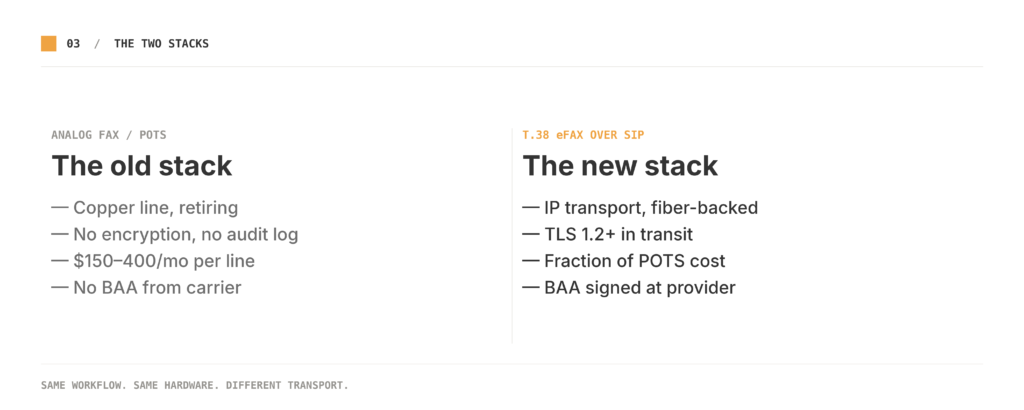
The two stacks — Analog fax over POTS vs. T.38 eFax over SIP
The two replacements you’ve probably been pitched. One of them is bad.
Option A: Cloud fax apps over public internet.
You get a web portal, a dedicated fax number, and a mobile app. Fine for low volume. But you’re also handing your inbound and outbound PHI to a third-party SaaS you don’t control, your existing fax hardware becomes a paperweight, and the monthly per-user pricing adds up fast across a practice.
Option B: T.38 eFax over your SIP trunk.
Same fax machines. Same phone numbers. Same workflows. But the transport underneath is a modern SIP trunk with T.38 fax protocol, not copper.
T.38 was built specifically for this. It encapsulates fax signal into IP packets, handles the timing and packet loss that kills G.711 attempts, and includes redundancy so a dropped packet doesn’t kill a full transmission. (3CX, 2025)
You keep the workflow your staff is trained on. You shed the copper. You pay a fraction of what POTS costs you now. And the SIP trunk sits behind a BAA you actually own.

Volli eFax — one trunk, no copper. T.38, HIPAA BAA, geo-redundant, no per-page metering
What we built.
Volli eFax over Volli Connect SIP.
One trunk. Full T.38. HIPAA BAA signed at the provider level. Failover across two geo-redundant carrier PoPs. No per-page metering on the trunk. And your existing fax hardware — ATA, MFP, IP-PBX, analog machine — keeps working.
We’ve been running it in the field since 2009 on the SIP side. The T.38 layer is the newer part, and it’s where most of the HIPAA-driven migrations are happening right now.
If you’re running more than two analog fax lines in a compliance-regulated environment — healthcare, legal, financial services, behavioral health — this should already be on your roadmap. The copper sunset isn’t a future event. It’s a 180-day notice waiting to land in your inbox.